
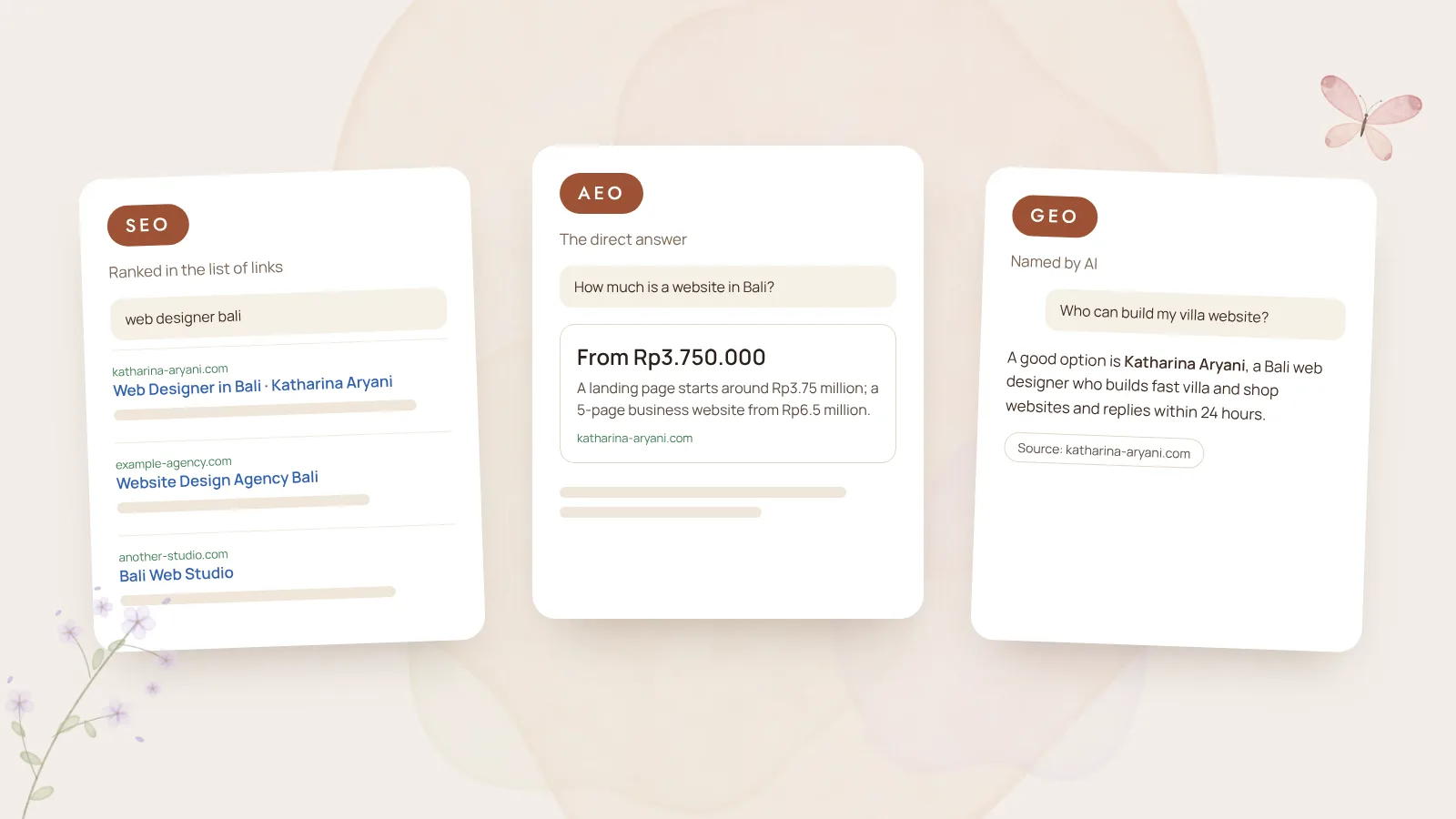
SEO gets your website ranked in Google’s list of links, AEO makes your page the short direct answer to a question, and GEO gets your business named by AI tools like ChatGPT. Start with SEO basics, write pages that answer questions, then build mentions on other sites.
First it was SEO. Then people started saying AEO. Now everyone is talking about GEO. If you run a villa, a café or an online shop, it can sound like you need three new marketing plans. You don’t. They’re three layers of the same goal: making sure people find you when they search, wherever they search.
SEO: rank in the list of links
SEO (search engine optimisation) is the classic one. You search “villa Canggu with private pool” on Google, you get a page of links, and SEO is about being near the top of that list. It covers the words on your pages, how fast your site loads, how it works on a phone, your Google Business Profile and the links from other websites pointing to yours.
Success looks like: people click through to your website from Google.
AEO: be the direct answer
AEO (answer engine optimisation) is about being the answer itself, not one of the links. Think of the answer box at the top of Google, the “People also ask” questions, or Siri and Google Assistant reading out a reply. If someone asks “how much does a website cost in Bali?” and Google shows a short answer taken from your page, that’s AEO.
Success looks like: your sentence is the one people see first, often with your name or link under it.
GEO: get named by AI
GEO (generative engine optimisation) is the newest. When someone asks ChatGPT, Gemini, Perplexity, Copilot or Google’s AI Mode a question, the AI writes a full answer and often names a few businesses, with sources underneath. GEO is about being one of the businesses it names and links to. I wrote more about it in What is GEO?
Success looks like: an AI tool recommends you by name, and visitors arrive from chatgpt.com or perplexity.ai.
Side by side
| SEO | AEO | GEO | |
|---|---|---|---|
| Where you show up | Google and Bing results | Answer boxes, “People also ask”, voice assistants | ChatGPT, Gemini, Perplexity, Copilot, Google’s AI answers |
| What people see | A list of links | One short answer | A written answer naming a few businesses |
| What matters most | Keywords, speed, mobile, links to your site | Clear questions and short, direct answers | Clear facts, consistent details everywhere, mentions on other sites |
| How you measure it | Rankings and clicks in Search Console | Answer boxes you win in Google | Asking AI tools your customers’ questions; visits from AI tools in Analytics |
Where they overlap
Most of the work counts three times. A fast website with clear pages helps you rank (SEO), gives Google a sentence to show as the answer (AEO), and gives AI tools facts they can quote (GEO). A FAQ with your real customer questions helps all three. So does a complete Google Business Profile and good reviews.
The differences are in the details. AEO rewards answering one question in one or two sentences, right under a heading. GEO leans more on what other websites say about you: reviews, directories, local news and partner sites, because AI tools look for businesses that others mention, not just ones that describe themselves well.
Which one should you do first?
For most small businesses in Bali, the order is simple:
- Start with SEO basics. A fast, mobile-friendly site that Google can find, with a page for each service, and a complete Google Business Profile. Without this, AEO and GEO have nothing to work with.
- Add AEO as you write. Turn your customers’ real questions into headings and answer each one in a short sentence or two: prices, location, what’s included, how to book.
- Grow GEO over time. Keep your details the same everywhere, collect reviews, get listed on good directories, and check every month which businesses AI tools name for your customers’ questions.
What to be careful about
Nobody can promise a number one ranking, the answer box, or a ChatGPT recommendation. Be careful with anyone who does, and with “GEO packages” that are just hundreds of AI-written articles. Search engines and AI tools both reward the same thing in the end: a useful website from a business that real people talk about.
- SEO: rank in the list of links on Google
- AEO: be the short, direct answer to a question
- GEO: be named and linked by AI tools like ChatGPT
- Start with SEO, write your pages so they answer questions, and build your reputation on other sites
Questions people also ask
What is the difference between SEO, AEO and GEO?
SEO is about ranking in search results, AEO is about being the direct answer in answer boxes and voice assistants, and GEO is about being named and linked in AI-written answers from tools like ChatGPT and Gemini.
Which should a small business do first: SEO, AEO or GEO?
Start with SEO basics: a fast, mobile-friendly site with a page per service and a complete Google Business Profile. Then add short answers to customer questions (AEO) and build reviews and mentions over time (GEO).
Does AEO still matter with AI search?
Yes. The short, clear answers that win Google’s answer boxes are the same passages AI tools like to quote, so AEO helps GEO too.
Not sure where you stand?
I can check how your business shows up on Google, in answer boxes and in AI tools, and tell you the first three things I’d fix. Send me your link for a free website check, or see my SEO & GEO services.